Research
Gravitational-wave astronomy
Gravitational waves are freely propagating oscillations in spacetime. General Theory of Relativity, propounded by Albert Einstein, predicts that accelerating masses produce gravitational waves (analogous to accelerating charges producing electromagnetic waves). In particular, violent astrophysical phenomena such as mergers of two black holes are powerful sources of gravitational waves. Even though gravitational waves carry away enormous amounts of energy and angular momentum from these sources, their interaction with matter is extremely weak, which makes their detection a tremendous experimental challenge. Although gravitational waves have not yet been directly detected, observation of the orbital decay of binary pulsars have provided strong indirect evidence of their existence. Currently a worldwide network of gravitational-wave detectors are engaged in an exciting search for these elusive waves. Gravitational-wave observations hold the potential to address key questions in fundamental physics, astrophysics and cosmology.
My research
My research spans different aspects of gravitational-wave (GW) astronomy: modeling of GW sources by combining analytical and numerical relativity, GW data analysis, interpretation of GW observations, and developing techniques for distinguishing between actual GW triggers and spurious instrumental triggers.
Modeling of GWs from the inspiral, merger and ringdown of binary black holes: Coalescence of astrophysical black-hole binary systems is among the most promising sources for the first detection of GWs. Such systems can be formed in a variety of astrophysical environments. Once formed, the system loses energy and angular momentum by means of GW emission and starts to inspiral towards each other. At the end of a long inspiral that lasts over millions to billions of years, the black holes merge into each other in a violent event. Binary-black-hole coalescences, during which 1-10% of the rest mass of the black holes is radiated as GWs, are the most energetic phenomena known in the Universe since the Big Bang.
Coalescence of binary black holes involves three stages: In the early stage, the inspiral is driven by the loss of orbital energy and angular momentum through GW emission. Eventually approaching the ultra-relativistic (v/c ~ 1) regime, the two bodies merge to form a perturbed Kerr black hole. In the ringdown stage, the perturbed black hole loses its deformations by emitting a spectrum of quasi-normal modes. Binary black holes are remarkably “clean” sources – the expected GW signals can be accurately computed in General Relativity and easily parametrized in terms of the component masses and spins. GW signals from the inspiral and ringdown stages can be computed by perturbation techniques, while accurate modeling of the merger stage (where gravity is strong, nonlinear and highly dynamical) requires numerical computation of exact solutions employing large supercomputers. Perturbative calculations have been developed and were being continuously improved (by calculating higher order terms in the perturbative expansions) over the last several decades; but numerical-relativity simulations have been successful only since 2005 .
GW signals from compact binaries deeply buried in the noisy detector data are extracted by the matched filtering technique, which involves cross correlating the data with theoretical templates of the expected signals. Source parameters are estimated by comparing the data with theoretical GW templates. In addition, availability of the observational data and accurate models of the expected signals will enable us to perform unique and powerful tests of General Relativity using binary black holes. Modeling the expected GW signals is thus a key goal in current research in gravitation.
Performing numerical simulations over the entire parameter space of binary black holes is computationally prohibitive; thus attacking the problem requires a combination of analytical and numerical relativity. The main aspect of my research is the modeling the expected GW signals from the coalescence of binary black holes by combining perturbative calculations with large-scale numerical simulations. The waveforms developed by our collaboration are currently employed in the search for GWs from binary black holes in the data of LIGO-Virgo observatories, enabling us to significantly improve the sensitivity of the searches and the accuracy with which the source parameters can be estimated from GW observations.
Developing searches for GWs from spinning compact binaries: Black holes in nature are likely to be highly spinning. If the spins are misaligned with the orbital angular momentum of the binary, the spins will precess, like a spinning top. This causes the orbital angular momentum also to precess (in order to conserve the total angular momentum over the precession time scales). Since GWs are predominantly beamed along the direction of the orbital angular momentum, the GW signals observed by a fixed detector in space will observe complicated amplitude- and phase modulations. A full description of the observed waveforms requires the use of a large number of parameters (two masses, six spin components, two inclination angles etc). Thus, it has been known for a while that implementing a matched-filter search over the full parameters space of spinning compact binaries is computationally prohibitive.
Some of our recent work has lead to the observation that modeling just the secular effects of spin (as opposed to the modulational effects of precession) will be sufficient for the detection of spinning binaries with comparable masses (mass ratio < 10). This is essentially due to the fact that, in the case of comparable-mass binaries, the total angular momentum is dominated by the orbital angular momentum. Hence, the orbital precession required to conserve the total angular momentum (by “compensating” for the spin precession) is rather small. It turned out that, the secular spin effects in the waveform templates can be described approximately using a single spin parameter. This enables us to search for spinning compact binaries using “template banks” described by three parameters (two masses and one spin parameter).
Parameter estimation of binary black holes: Any type of measurement in noisy data is affected by two types of errors: statistical and systematic. Statistical errors are caused by the intrinsic stochastic nature of the noise. Given a signal model, some information-theoretical bounds can be placed on the best expected accuracy of the measurement. The more information content the signal has, the better will be the measurement accuracy. Prior to the numerical-relativity revolution, searches for GWs from binary black holes were performed employing waveform templates modeling only the inspiral or ringdown parts of the signal (computed by perturbative calculations). We demonstrated that a search employing templates that coherently combine the inspiral, merger and ringdown stages is not only more sensitive in detecting signals, but also provides superior accuracy in estimating the source parameters. The use of templates describing the complete coalescence was also found to improve the expected accuracy of various tests of general relativity using future GW observations.
We also worked on characterizing the systematic errors in estimating the parameters of binary black holes using templates describing only the inspiral stage.
Vetoes for transient GW triggers using instrumental coupling models: Since interferometric GW detectors are highly complex instruments, the data often contain a large number of noise transients that are not easily distinguishable from possible GW signals. In order to perform a sensitive search for transient GW signals, it is important to identify these noise artifacts, and to “veto” them. We developed a new class of veto methods that make use of our understanding of the coupling of different noise sources to the “GW channel” of the detector. The main idea here is that it is possible to predict how a noise transient recorded by an instrumental channel would appear in the GW channel by modeling the coupling of this channel to the GW channel. If a transient in the GW channel is causally related to one in an instrumental channel, it has to be consistent with the “prediction”.
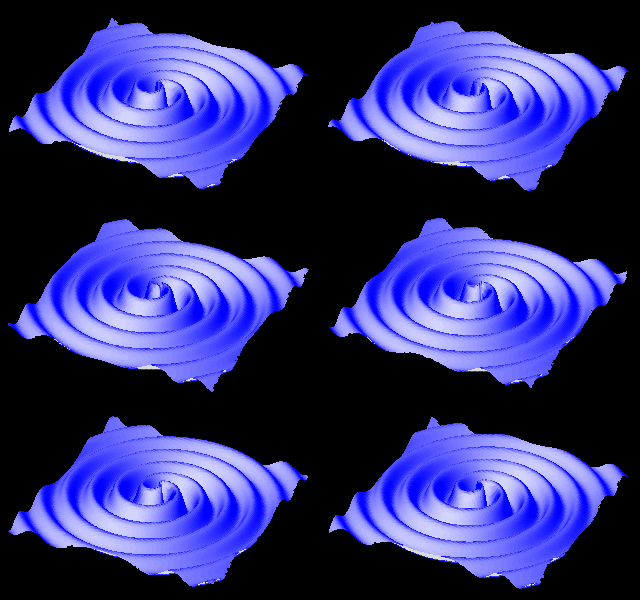
Gravitational waves can be thought of as ripples in spacetime that propagate with the speed of light. [Pic. NASA]
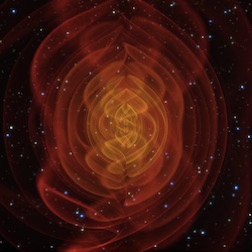
Visualization of a numerical simulation showing the GWs generated by the merger of two black holes. The stars are there just to make the picture pretty! (NASA/GSFC)